Showing posts with label ATOMIC AND NUCLEAR PHYSICS 23BPH5C2 2025 V SEMESTER. Show all posts

Semi Empirical Mass Formula - Liquid Drop Model of the Nucleus

Semi-Empirical Mass Formula [Bethe-Weizsäcker Formula]

Derivation and Explanation
Statement:
The Semi‑Empirical Mass Formula (SEMF) gives the nuclear binding energy \(B(A,Z)\) of a nucleus with mass number \(A\) and atomic number \(Z\) as the sum of five macroscopic terms derived from the liquid‑drop model:
Formula :
\[B(A,Z)=a_V A - a_S A^{2/3} - a_C \frac{Z(Z-1)}{A^{1/3}} - a_A \frac{(A-2Z)^2}{A} + \delta(A,Z)\]
Sometimes the Coulomb term is written as \(a_C \dfrac{Z^2}{A^{1/3}}\) and the pairing term \(\delta\) has the usual form given below.

Derivation: Physical origin of each term :

Semi‑Empirical Mass Formula Bethe Weizsacker Formula

Volume term \(a_V A\) :

The nucleus behaves like an incompressible liquid drop. Each nucleon binds with a roughly constant number of nearest neighbours, so binding energy is proportional to \(A\). Hence \(a_V A\) with \(a_V>0\).


Surface term \(-a_S A^{2/3}\) :

Nucleons at the surface have fewer neighbours and so contribute less binding. Surface area scales as \(A^{2/3}\), giving a negative correction \(-a_S A^{2/3}\).


Coulomb term \(-a_C Z(Z-1)/A^{1/3}\) :

Protons repel by Coulomb force. Approximating the nucleus as a uniformly charged sphere of radius \(R\propto A^{1/3}\) leads to electrostatic energy \(\propto Z^2/R \sim Z^2/A^{1/3}\). The factor \(Z(Z-1)\) corrects for self‑interaction.


Asymmetry (or Pauli) term \(-a_A (A-2Z)^2/A\) :

Quantum mechanically, neutrons and protons fill Fermi levels. Minimum energy occurs when \(N\approx Z\) for small nuclei. Deviation from symmetric \(N=Z\) costs kinetic (Fermi) energy, producing a term quadratic in \(N-Z\): since \(N=A-Z\), this becomes \((A-2Z)^2/A\).


Pairing term \(\delta(A,Z)\) :

Because of pairing, nuclei with even numbers of protons and neutrons are extra stable. Empirical form: \[\delta(A,Z)=\begin{cases} +a_P A^{-1/2} & \text{even-}Z,\,\text{even-}N\\ -a_P A^{-1/2} & \text{odd-}Z,\,\text{odd-}N\\ 0 & \text{if } A \text{ is odd}\end{cases}\] This term is small and alternates sign depending on nucleon parity.


Notes on coefficients and units :
Typical fitted values(approximately): \(a_V = 15.5 \, MeV\)
\(a_S = 17.0 \, MeV\)
\(a_C = 0.71 \, MeV\)
\(a_A = 23.0 \, MeV\)
\(a_P = 11.0 \, MeV\)

These are empirical — obtained by fitting measured nuclear masses.

Short derivation sketch for asymmetry term :

Treat protons and neutrons as independent Fermi gases. Fermi energy scales as \(E_F\propto (n)^{2/3}\) where density \(n\) differs when \(N\ne Z\). Expanding the total kinetic energy to second order in the neutron excess gives an energy contribution \(\propto (N-Z)^2/A\), producing the asymmetry term shown above.

Example / application & remarks :

Binding energy per nucleon \(B/A\) predicted by SEMF peaks near \(A\sim 56\), explaining iron‑group stability and why heavy nuclei fission while light nuclei fuse. SEMF also predicts approximate mass parabolae and decay energetics (Q‑values) qualitatively well.

Anomalous Zeeman Effect and Paschen-Back Effect

Anomalous Zeeman Effect

Zeeman and Paschen Back Effect Diagram
Definition:
The Anomalous Zeeman Effect is the splitting of spectral lines into more than three components when an atom is placed in an external magnetic field, typically observed in atoms having unpaired electron spin and non-zero total angular momentum.

Explanation :

  1. In the normal Zeeman effect only orbital angular momentum is considered and energy levels split into three (a triplet) because of simple magnetic interaction.
  2. Most atoms, however, have both orbital L and spin S angular momenta which couple to give total angular momentum J. The interaction with the magnetic field depends on the Landé g-factor (gJ), not just on orbital motion.
  3. Each atomic level splits into (2J + 1) magnetic sublevels labelled by mJ, producing multiple components in the observed spectral lines. Selection rules (ΔmJ = 0, ±1) determine which transitions are allowed, giving a complex pattern of π and σ lines.
  4. The anomalous effect thus reveals the role of electron spin and the vector coupling of L and S, and was historically important evidence for the existence of electron spin and for quantum theory.

Key formula:

\[\Delta E = \mu_B\, g_J\, B\, m_J\]

where \(\mu_B\) is the Bohr magneton, \(B\) is the magnetic field, \(g_J\) is the Landé g-factor, and \(m_J\) is the magnetic quantum number.

Paschen Back Effect :

In very strong magnetic fields, the coupling between orbital angular momentum \(L\) and spin \(S\) breaks down. The magnetic interaction becomes dominant compared to spin orbit coupling, causing \(L\) and \(S\) to align independently with the field. This leads to a simpler splitting pattern than the anomalous Zeeman effect, similar to the normal Zeeman effect.

This occurs When magnetic energy \(\mu_B B\) is much greater than spin orbit interaction energy.

Threshold Energy For Nuclear Reaction

Threshold Energy in Nuclear Reactions

Nuclear Reaction Diagram

In nuclear physics, the threshold energy is the minimum kinetic energy that a projectile particle must possess in order to make a particular nuclear reaction occur.

Definition

The threshold energy for a nuclear reaction is defined as the minimum energy of the incoming particle required to overcome the energy difference between the reactants and the products, ensuring the reaction can proceed while conserving both energy and momentum.

Explanation

If a reaction absorbs energy (i.e., it is endothermic), the projectile must supply not only this reaction energy but also additional energy to satisfy momentum conservation. Thus, the actual threshold energy is slightly higher than the reaction’s Q-value (when Q is negative).

Threshold Energy (Eth) = −Q × (1 + ma / MA)

where Q is the reaction energy, ma is the mass of the projectile, and MA is the mass of the target nucleus.

Example

In the reaction p + ³H → ³He + n, if the reaction Q-value is negative, the proton must have at least the threshold energy computed from the above relation for the reaction to take place.

Summary

The concept of threshold energy helps determine the minimum energy requirement for initiating endothermic nuclear reactions and plays a vital role in nuclear reactor design and particle accelerator physics.
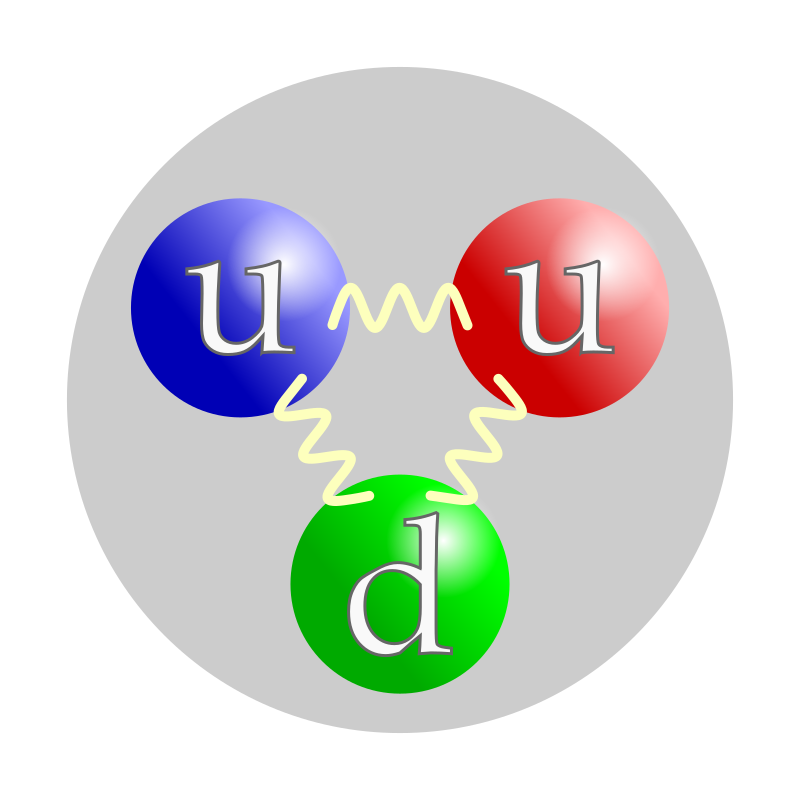
Isospin - Explanation and Defintion

Isospin (Isotopic Spin) in Nuclear Physics

Cosmic Ray Shower Illustration

Isospin or isotopic spin is a fundamental concept in nuclear and particle physics that helps explain the strong interaction between nucleons — protons and neutrons. The term was introduced by Werner Heisenberg in 1932 to describe the striking similarity in the behavior of protons and neutrons under the strong nuclear force.

Definition

Isospin may be defined as a quantum number that treats the proton and neutron as two different states of the same particle (the nucleon), differing only by their electric charge. It is analogous in mathematics to ordinary spin, but it does not represent physical rotation — rather, it represents an internal symmetry related to the strong force.

Concept and Analogy

The idea behind isospin is that the strong nuclear force does not depend on electric charge — it acts equally on protons and neutrons. Thus, they can be considered as two members of an isospin doublet:

Particle Isospin (I) Isospin Projection (I3)
Proton (p) 1/2 +1/2
Neutron (n) 1/2 −1/2

Here, the total isospin \( I = \frac{1}{2} \) for both particles, while the component \( I_3 \) distinguishes between them. This analogy closely resembles spin-up and spin-down states in quantum mechanics.

Isospin Multiplets

Isospin symmetry extends beyond nucleons to other hadrons that experience the strong force. Particles that differ only in charge but have similar masses and interactions form isospin multiplets. For example:

  • The three pions (π+, π0, π) form an isospin triplet with \( I = 1 \).
  • The nucleons (proton and neutron) form an isospin doublet with \( I = 1/2 \).

Significance of Isospin

The concept of isospin is extremely useful in simplifying nuclear and particle physics problems:

  • It explains why the strong nuclear force is nearly charge-independent.
  • It allows classification of particles into groups (multiplets) with similar strong interaction properties.
  • It provides a symmetry principle that was later generalized in the framework of SU(2) and SU(3) symmetry groups.

Conclusion

In summary, isospin is not a physical spin but an abstract quantum number representing a symmetry between protons and neutrons under the strong nuclear force. It remains a cornerstone in understanding hadronic interactions and the classification of subatomic particles.

Cosmic Rays - Latitude and Longitude Effect

Latitude and Altitude Effects on Cosmic Rays

Cosmic Rays Latitude and Longitude Effect

Latitude Effect

Definition: Latitude effect may be defined as the effect that shows the intensity of the cosmic rays with the geometrical latitude. It shows that the intensity of the cosmic rays is maximum at the poles where geometrical latitude is and is minimum at the equator where the geometrical latitude is.

The Earth's magnetic field is the main reason for the decrease in cosmic ray intensity at the equator. In the poles, the charged particles are travelling parallel to the direction of the magnetic field. Thus, they can travel to Earth almost unhindered, so the intensity is always maximum at the poles. But when we consider the scenario of the equator, the charged particles have to travel in a perpendicular direction to the field and face the maximum hindrance. Only the particles having enough energy to cut through this barrier can reach the equator, thus we get minimum intensity at the equator.

In summary, cosmic ray intensity increases with latitude and is maximum at the poles due to the Earth's magnetic field orientation.

Altitude Effect

Definition: It may be defined as the effect which shows the variation of the cosmic rays intensity with the altitude (height). The cosmic rays intensity increases with the increase of the altitude and is maximum when we reach an altitude of about 20 km. If we further increase the altitude then the intensity of the cosmic rays decreases. This effect is called the altitude effect.

The latitude effect is generally known as the change of the physical quantity with change in latitude whereas the altitude effect is the change of the physical quantity with respect to the change in the height.

Thus, while the latitude effect depends on geomagnetic influence, the altitude effect reflects atmospheric absorption and particle generation processes.

© 2025 | KAZ Educational Blog

Properties of Thermal Neutrons Vs Fast Neutrons

Property Thermal Neutrons Fast Neutrons
Definition Neutrons in thermal equilibrium with surroundings (low kinetic energy). High kinetic energy neutrons emitted from nuclear reactions.
Typical Energy Range ≈ 0.025 eV (at ~300 K) ≈ 1 MeV – 10 MeV (or higher)
Speed ≈ 2,200 m/s ≈ 10⁷ m/s
Source Produced when fast neutrons are slowed by a moderator (water, graphite, heavy water). Produced directly from fission or other nuclear reactions.
Interaction with Nuclei High probability of absorption and inducing fission in certain isotopes (e.g., U-235). Lower absorption probability; more likely to cause scattering (elastic/inelastic).
Use in Reactors Used in thermal reactors (with moderators) to sustain chain reactions. Used in fast reactors/breeder reactors (no moderator) for breeding and fast-spectrum reactions.
Cross-section (Interaction Probability) Generally higher absorption and fission cross-sections for many fissile nuclei. Generally lower absorption cross-sections; scattering dominates.

Spectral Terms and Notations

Spectral Terms and Notation in Atomic Physics

Spectral terms provide a compact way of describing the quantum states of electrons in atoms. They summarize the total orbital angular momentum, spin, and multiplicity of a given electronic configuration.

General Form of a Spectral Term

A spectral term is written as:

$$^{2S+1}L_J$$

  • S: Total electron spin quantum number.
  • 2S+1: Multiplicity (singlet, doublet, triplet, etc.).
  • L: Total orbital angular momentum, denoted by letters (S, P, D, F, ... for L=0,1,2,3,...).
  • J: Total angular momentum, combining L and S, ranging from \( \lvert L+S \rvert \) to \( \lvert L-S \rvert \) in steps of 1.

Examples of Spectral Terms

(a) Hydrogen Ground State

The electron has spin \(S = \tfrac{1}{2}\) and orbital angular momentum \(L = 0\). Thus:

$$^{2}S_{1/2}$$

This represents a doublet-S state with total \(J = 1/2\).

(b) Helium \(1s2s\) Configuration

For two electrons, spins can pair to form either:

  • Singlet state: \(S=0\), term \(^1S_0\)
  • Triplet state: \(S=1\), term \(^3S_1\)

This splitting explains why helium exhibits both singlet and triplet spectral series.

Notes on Multiplicity

The multiplicity \(2S+1\) determines how many closely spaced energy levels appear. Higher multiplicity (like triplets) often correspond to lower energy due to electron exchange effects.

In short, spectral term notation provides a compact way to describe the structure of atomic energy levels.

Invariance of Maxwell Equations Under Parity Transformation [NOT IN THE SYLLABUS. EXPLANETORY NOTE FOR PARITY VIOLATION IN BETA DECAY]

Maxwell’s Equations and Parity Invariance

One of the most beautiful features of Maxwell’s equations is their symmetry. In this post, we will prove that Maxwell’s equations are invariant under a parity transformation (spatial inversion).

1. What is a Parity Transformation?

A parity transformation (spatial inversion) is defined by:

\[ \hat{\mathbf{P}} \;\longmapsto\; \mathbf{r}' = -\mathbf{r}, \qquad t' = t \]

Transformation rules:

  • Polar vector \( \mathbf{V} \): \(\mathbf{V}'(\mathbf r',t) = -\mathbf{V}(\mathbf r,t)\)
  • Axial vector \( \mathbf{W} \): \(\mathbf{W}'(\mathbf r',t) = +\mathbf{W}(\mathbf r,t)\)
  • Scalar \( \rho \): \(\rho'(\mathbf r',t) = \rho(\mathbf r,t)\)

Gradient operator: \[ \nabla' = \frac{\partial}{\partial \mathbf r'} = -\nabla \]

In Maxwell’s theory:

  • \( \mathbf{E}, \mathbf{J} \) are polar vectors
  • \( \mathbf{B} \) is an axial vector
  • \( \rho \) is a scalar

2. Maxwell’s Equations in SI Units

\[ \begin{aligned} &(1) \quad \nabla \cdot \mathbf{E} = \frac{\rho}{\varepsilon_0} \\[6pt] &(2) \quad \nabla \cdot \mathbf{B} = 0 \\[6pt] &(3) \quad \nabla \times \mathbf{E} = - \frac{\partial \mathbf{B}}{\partial t} \\[6pt] &(4) \quad \nabla \times \mathbf{B} = \mu_0 \mathbf{J} + \mu_0 \varepsilon_0 \frac{\partial \mathbf{E}}{\partial t} \end{aligned} \]

3. Applying Parity

(1) Gauss’s Law for \( \mathbf{E} \)

\[ \nabla' \cdot \mathbf{E}' = (-\nabla) \cdot (-\mathbf{E}) = \nabla \cdot \mathbf{E} \] \[ \rho'/\varepsilon_0 = \rho/\varepsilon_0 \] ✅ Invariant.

(2) Gauss’s Law for \( \mathbf{B} \)

\[ \nabla' \cdot \mathbf{B}' = (-\nabla) \cdot (+\mathbf{B}) = -\nabla \cdot \mathbf{B} \] Since RHS = 0, equation is unchanged. ✅ Invariant.

(3) Faraday’s Law

\[ \nabla' \times \mathbf{E}' = (-\nabla) \times (-\mathbf{E}) = \nabla \times \mathbf{E} \] \[ -\frac{\partial \mathbf{B}'}{\partial t} = -\frac{\partial \mathbf{B}}{\partial t} \] ✅ Invariant.

(4) Ampère–Maxwell Law

\[ \nabla' \times \mathbf{B}' = (-\nabla) \times (+\mathbf{B}) = -(\nabla \times \mathbf{B}) \] \[ \mu_0 \mathbf{J}' + \mu_0 \varepsilon_0 \frac{\partial \mathbf{E}'}{\partial t} = \mu_0 (-\mathbf{J}) + \mu_0 \varepsilon_0 \frac{\partial (-\mathbf{E})}{\partial t} \] \[ = -\left(\mu_0 \mathbf{J} + \mu_0 \varepsilon_0 \frac{\partial \mathbf{E}}{\partial t}\right) \] Both sides gain the same minus sign. ✅ Invariant.

4. Continuity Equation

\[ \frac{\partial \rho'}{\partial t} + \nabla' \cdot \mathbf{J}' = \frac{\partial \rho}{\partial t} + (-\nabla) \cdot (-\mathbf{J})\] \[ = \frac{\partial \rho}{\partial t} + \nabla \cdot \mathbf{J} = 0 \]

5. Conclusion

By treating \( \mathbf{E} \) as a polar vector, \( \mathbf{B} \) as an axial vector, and assigning the correct transformation rules to sources, we find that all four Maxwell equations remain unchanged under parity transformation.

This symmetry is one of the many reasons Maxwell’s theory is so elegant: it respects both the structure of space and the distinction between vectors and pseudovectors.


Properties of Alpha, Beta, and Gamma Rays

Properties of Alpha, Beta, and Gamma Rays

Property Alpha Rays Beta Rays Gamma Rays
Nature Helium nuclei (2 protons, 2 neutrons) High-energy electrons or positrons High-energy electromagnetic waves (photons)
Charge +2e (positive) -e (electrons) or +e (positrons) Neutral (0)
Mass ~4 u (6.644 × 10⁻²⁷ kg) ~1/1836 u (9.109 × 10⁻³¹ kg) Massless
Penetration Power Low (stopped by paper or a few cm of air) Moderate (stopped by a few mm of aluminum) High (requires several cm of lead or meters of concrete)
Ionization Ability High (strong interaction with matter) Moderate (less than alpha) Low (minimal interaction)
Speed ~5-10% of speed of light (~1.5-3 × 10⁷ m/s) Up to 99% of speed of light (~3 × 10⁸ m/s) Speed of light (3 × 10⁸ m/s)

Stern and Gerlach Experiment - Lecture Notes For Atomic Physics


Consolidated Question Bank - Atomic and Nuclear Physics 23BPH5C2 2025

UNIT - I
PART A - 2 MARK QUESTIONS

1. Mention any two drawbacks of Bohr's atom model.
2. What is meant by spatial quantization?
3. Differentiate between LS and JJ coupling.
4. State Pauli's exclusion principle.
5. Define Bohr Magneton and State its formula.
6. What is the outcome of Stern-Gerlach experiment?
7. Write any two selections rules.

PART B - 5 MARK QUESTIONS

1. Explain the Vector atom model and list the associated quantum numbers.
2. Describe the Stern-Gerlach experiment and its significance.
3. Derive the expression for magnetic dipole moment due to orbital and spin motion of the electron.
4. State and explain the selection rules and intensity rule for atomic transitions.

PART C - 10 MARK QUESTIONS

1. Explain the Vector Atom Model in detail. Discuss the quantum numbers associated with it and their significance.
2. Describe the Stern–Gerlach experiment.
3. Discuss in detail L–S coupling and J–J coupling schemes. 

UNIT - II
PART A - 2 MARK QUESTIONS

1. What is meant by excitation potential?
2. Define ionization potential.
3. What are spectral terms? Give an example.
4. Write the notation for the term symbol of the ground state of sodium.
5. What is Zeeman effect?
6. State Larmor’s theorem.
7. Differentiate between normal and anomalous Zeeman effect.
8. What is Paschen–Back effect?
9. What is the Stark effect?

PART B - 5 MARK QUESTIONS

1. Distinguish between excitation potential and ionization potential.
2. Describe Davis and Goucher’s method for the measurement of excitation and ionization potentials.
3. Explain spectral terms and term symbols with suitable examples.
4. Describe the fine structure of sodium D-lines.
5. Write a note on the Paschen–Back effect.

PART C - 10 MARK QUESTIONS

1. Describe the Zeeman effect. State Larmor's theorem and explain the quantum mechanical explanation of the normal Zeeman effect.

UNIT - III
PART A - 2 MARK QUESTIONS

1. State Geiger-Nuttal law.
2. List any two properties of alpha particles.
3. Define nuclear isomerism.
4. What is meant by internal conversion?
5. Write note on non-conservation of parity in weak interactions.
6. What are the characteristics of beta rays?
7. State any two properties of gamma rays.

PART B - 5 MARK QUESTIONS
1. State and Explain Geiger-Nuttal law.
2. Write short notes on the properties of alpha, beta, and gamma rays.
3. Explain Gamow's theory of alpha decay.
4. Describe the beta-ray spectrum and explain how it led to the prediction of the neutrino.
5. Write note on internal conversion.
6. Explain nuclear isomerism with an example.

PART C - 10 MARK QUESTIONS
1. Explain the properties of alpha, beta, and gamma rays. How are they distinguished experimentally?
2. Describe Geiger–Nuttall law. Discuss Gamow’s theory of alpha decay and explain how it accounts for the law.
3. Discuss the beta ray spectrum. Explain the neutrino theory of beta decay and how it resolves the conservation issues.
4. What is nuclear isomerism? Explain internal conversion and discuss the violation of parity in weak interactions.

UNIT - IV
PART A - 2 MARK QUESTIONS

1. State any two conservation laws applicable to nuclear reactions.
2. What is meant by Q-value of a nuclear reaction?
3. Define threshold energy.
4. What is scattering cross section?.
5. What is artificial radioactivity? Give an example.
6. Mention any two applications of radio isotopes.
7. Differentiate between thermal neutrons and fast neutrons.

PART B - 5 MARK QUESTIONS
1. State and explain the conservation laws involved in a nuclear reaction.
2. Derive the Q-value equation for a nuclear reaction. What does a positive or negative Q value indicates?
3. Define threshold energy. Derive an expression of an endoergic nuclear reaction.
4. What is artificial radioactivity? Explain with a suitable reaction. 
5. Compare the liquid drop model and shell model of the nucleus.

PART C - 10 MARK QUESTIONS
1. Derive the Q-value equation for a nuclear reaction explain its significance.
2. Explain the concept of threshold energy. Derive the expression for threshold energy in an endoergic reaction.
3. Discuss the liquid drop model of the nucleus. Explain how it accounts for nuclear binding energy and fission.
4. Explain the shell model of the nucleus. How does it account for magic numbers and nuclear properties?.

UNIT - V
PART A - 2 MARK QUESTIONS

1. What are elementary particles? Give two examples.
2. Name the four fundamental interactions in nature.
3. What is isospin?
4. Define the strangeness quantum number.
5. What are quarks? Name any two types.
6. What is meant by latitude effect in cosmic rays?
7. Differentiate between primary and secondary cosmic rays.

PART B - 5 MARK QUESTIONS

1. Classify the elementary particles based on their interaction types.
2. Explain the concept of isospin and strangeness with suitable examples.
3. State the conservation laws obeyed in particle interactions.
4. Write a short note on quark model.
5. Describe the latitude and longitude effects of cosmic rays.

PART C - 10 MARK QUESTIONS

1. Classify the elementary particles. Explain their interaction and properties with suitable example.
2. Discuss the quantum numbers of elementary particles. Explain the significance of isospin and strangeness.
3. Explain the quark model of elementary particles. How do quarks combine to form hadrons?
4. Describe the discovery of cosmic rays. Differentiate between primary and secondary cosmic rays. Explain the latitude and altitude effects.